
deep
When something is deep, it’s far below the surface. This word is an adjective used to describe people and things such as water, snow, soil, holes, empty space, and a person’s thoughts.
- The snow is six inches deep outside.
- When you jump into a pool or a lake, make sure the water is deep enough so that you don’t hurt yourself.
- Explorers can go into a deep cave far below the surface of the earth.
- Deep holes are dug for foundations of buildings.
- Our teacher is a very deep thinker.
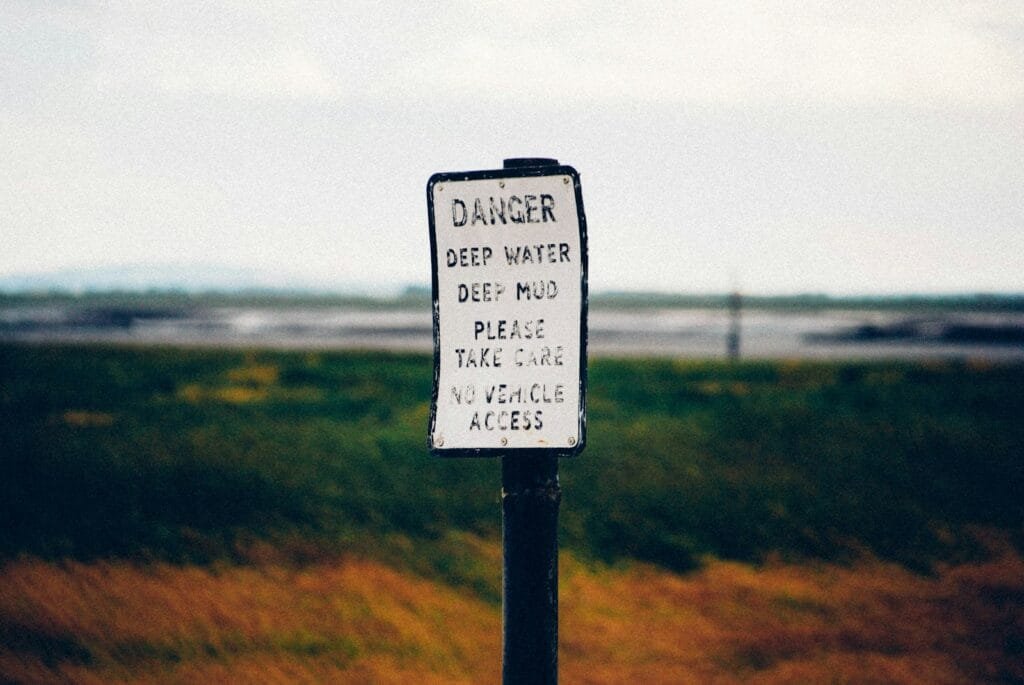
The water and the mud here are deep.
a. deep = a physical distance downward
The general direction of deep is down. Something goes far down into a substance. It can go into water, the soil, a type of material, or a person. As an adjective, “deep” also means low or severe. The opposite of “deep” is “shallow.”
- The water here is very deep.
- The construction workers dug a deep hole for the foundation.
- He has a deep cut on his arm from a knife.
- The snow is about six inches deep.
- That man has a deep voice. (The sound of his voice is low.)
a. deep = a physical distance downward

- A powerful telescope can look into the deep areas of the universe.

- Some caves go deep down into the Earth.
b. deep = far into a topic or situation
This use of the word “deep” has something to do with how involved a person is with a situation or another person.
- The love she feels for her husband is deep.
- They have a deep relationship.
- Tom is a very deep thinker.
- You’re in deep trouble.
- That’s deep. (Said when a person expresses a profound thought.)
- The company made deep cuts to its budget for next year.
- Maria has a deep understanding of the situation.
a. deep = far into a topic or situation

- The love they feel for each other is very deep.

- This little girl is in deep, deep trouble.
c. deeply -- adverb
The word “deeply” is an adverb, but sometimes you will hear the word “deep” used as an adverb as well.
- I am deeply sorry if I offended you. (The adjective “sorry” is modified by the adverb, “deeply.”)
- We are deeply troubled by the situation unfolding in the Middle East. (deeply troubled = adverb adjective)
- They care deeply for each other.
- He said he was deeply grateful for the help.
- She looked deep into his eyes. (Yes, it should be “deeply,” but it’s common to hear and read “deep” as an adverb.)
- They’re deep in debt. They’re deeply in debt. (Both are okay.)
- They went deep into debt. They went deeply into debt. (Both are okay.
- He’s going deep for a pass. (Said for a receiver in American football.)
- Why did you wake me? I was deep asleep.
c. deeply -- adverb

- Some people go deeply into debt because they pay for everything with credit cards .

- The people of the United States are deeply grateful for the service and leadership that Barack Obama provided for eight years as President.
d. depth -- noun
The word “depth” is a noun. This is a word for physical things, emotions, relationships, and the understanding of a topic.
- The depth of the water in this part of the lake is about 20 feet.
- The teacher went into great depth on the topic of conditional sentences in English.
- How do you measure the depth of a hole in the ground?
- The film we saw last night challenged the depths of our imaginations.
- She shows tremendous depth as an actress.
c. depth -- noun

- The depth of her sadness is hard for others to understand.

- The depth of the snow here is about two feet.